
How To Read Christofle Hallmarks on Tableware, Flatware, and Cutlery
- Posted on 9th December 2025
- in Christofle Silver
- by Alan
Christofle is a famous name in French silver and silver-plated tableware. Collectors, dealers, and fans of Christofle need to know how to read the hallmarks in order to tell if an item is real, when it was made, and whether it’s solid silver or silver-plated.
This guide explains the key Christofle silver marks, how to tell French silver marks from Christofle’s, how to spot the difference between silver and silverplate, and what to check to see if Christofle flatware and tableware are real and valuable.
What Do Christofle Silver Marks Mean?
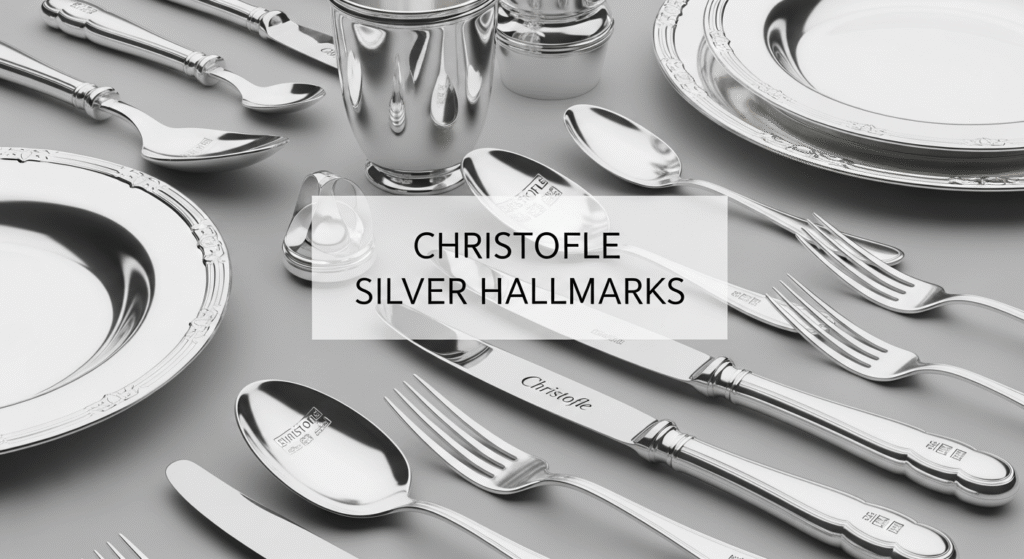
Small stamps on the metal are called Christofle hallmarks, maker’s marks, or silver marks. These marks tell you:
- The maker of the piece (Christofle maker’s marks like OC or CC)
- What kind of metal it is (for example, sterling silver or silver-plated)
- Sometimes the purity of the silver, plating standard, or date
- Sometimes the collection line, like Gallia
You can usually find Christofle silver marks on the back of cutlery handles, the underside of flatware, or, on tableware, less obvious places like the base or back of a handle.
Why Hallmarks Are Important to Collectors
Hallmarks are very important for collectors and resellers because they:
- Confirm authenticity (genuine Christofle vs. generic silverware)
- Help estimate the period of production
- Indicate whether a piece is solid silver or silver-plated
- Affect resale value
If you can’t read Christofle maker’s marks, you might pay too much for a common plated item instead of a valuable French silver piece. For example, a collector at an auction might bid eagerly, only to find out later that the item was silver-plated, not rare sterling. With the right knowledge, you can avoid these mistakes.
Differences Between Silver and Silver-Plated Marks
French silver marks on sterling silver follow national hallmark rules. For .950 or .800 silver, the Minerva head is commonly used.
Christofle silverplate marks, however, use Christofle’s own symbols:
- The name CHRISTOFLE
- A chess knight inside a lozenge
- Initials like OC, CC
- Numbers showing plating weight (84, 90, 100, 120)
If you see Christofle marks without the Minerva hallmark, the piece is almost certainly silver-plated.
Different Types of Christofle Hallmarks
Christofle hallmarks changed over the years, but some elements remained consistent. Common hallmarks include:
- Maker’s initials
- The chess knight
- The name CHRISTOFLE or CHRISTOFLE FRANCE
- Silver or plating indicators
The “OC” and “CC” Maker’s Marks
OC and CC are two of the most recognized Christofle marks: The OC mark is linked with early Christofle and associated silversmith partnerships, commonly used around circa 1844-1862. It is usually found in an oval or lozenge cartouche.
- CC mark – Stands for Charles Christofle. Often found on silver-plated items.
Collectors frequently search for “Christofle OC and CC marks” as a sign of authenticity.
The Christofle Chess Knight Mark
The chess knight is one of Christofle’s most iconic marks, mostly used on silver-plated items:
- Stamped in a diamond or lozenge
- Found alongside OC or CC initials
- Typically on the underside of flatware
If you see the knight hallmark, the item is most likely silver-plated, not sterling.
Gallia Collection Marks
Christofle’s Gallia line, introduced in the late 1800s, used a special alloy often silver-plated. Its hallmarks include:
- GALLIA or CHRISTOFLE GALLIA
- A rooster symbol on some pieces
- Maker’s initials
Gallia is collectible for design value, even though it is not solid silver.
Silverplate vs. Sterling Silver Marks
Silverplate marks usually include:
- CHRISTOFLE / CHRISTOFLE FRANCE
- Chess knight
- OC or CC initials
- Plating numbers (84, 90, etc.)
Sterling silver marks include:
- Minerva head (French national hallmark)
- Silver purity (.950 or .800)
The Christofle maker’s mark is a key way to identify their silver items. You’ll usually see it with assay marks and sometimes date letters, which help prove each piece is genuine. These marks appear together because of the hallmarking process: after testing the metal’s quality, the maker’s mark is added to confirm authenticity. Knowing this helps collectors and beginners understand why these marks are grouped together.
If there is no Minerva hallmark, it is not solid silver.
How to Date Christofle Silver
Dating is based on hallmark style, maker’s marks, and typography.
General eras:
- Mid-19th century: Early, complex marks
- Late 1800s–early 1900s: Chess knight introduced, Gallia hallmarks
- Pre-1935: Decorative cartouches, older fonts
- Post-1935: Cleaner, modernized marks, “CHRISTOFLE FRANCE” standard
Comparing your piece with reference hallmark charts is the best dating method.
Differences: Pre-1935 vs Post-1935
Pre-1935:
- More decorative frames
- Older “Christofle” fonts
- Frequent Gallia sub-marks
Post-1935:
- Cleaner hallmark shapes
- Consistent “CHRISTOFLE FRANCE” typography
- More modern design lines
French Date Letters
Sterling pieces may show French assay marks or date letters near Minerva. Use a French hallmark chart to interpret them.
Christofle Silver vs Silverplate — How to Tell?
Physical tests help:
- Weight: Solid silver may feel slightly heavier
- Color: Sterling has a softer white; silverplate is cooler in tone
- Wear points: Silverplate may show brass/copper base metal at edges, but be cautious about conducting physical tests that might damage the surface. Avoid using scratch-tests, as they can be destructive. Instead, consider a non-invasive method, such as the magnet test. Although it is not definitive for distinguishing silver from silver-plated items, it can still be helpful in certain cases without harming the item.
Christofle’s plating is thick, so not all pieces show wear.
How Christofle Used Electroplating?
Christofle pioneered electroplating in the 1800s:
- Base metal core (copper, nickel silver, brass)
- Even a silver layer added via electroplating
- Hallmarked with Christofle plating marks
- Plating thickness indicated by numbers
This made durable, beautiful silverware more affordable.
How to Verify Genuine Christofle?
Because Christofle is high-end, there are copies.
Signs of fake marks:
- Misspellings (e.g., “Christofel”)
- Shallow or blurry hallmark strikes
- Unusual combinations of symbols
To authenticate:
- Locate all hallmarks
- Verify correct sets (knight + OC/CC + CHRISTOFLE)
- Compare with reference photos.
- Check craftsmanship
- Match the design to Christofle catalogs.
For very old or valuable items, consult a professional appraiser.
How Much Is Christofle Silver Worth Today?
Value depends on:
- Material: Sterling > Silverplate; Gallia valued for design
- Condition: Minimal wear = higher value
- Pattern: Malmaison, Spatours, Rubans, Perles are highly collectible
- Set size: Full sets are worth more
- Age & rarity: Older or discontinued patterns sell for premium prices
Care and Storage Tips
- Hand-wash with mild soap
- Dry thoroughly
- Use quality silver polish sparingly
- Store in lined anti-tarnish chests
- Avoid moisture
- Use regularly to prevent tarnish buildup
Conclusion
When you know how to read Christofle hallmarks on cutlery, flatware, and tableware, you can find out who made the piece, what metal it’s made from, how old it is, and its possible value. This knowledge is key for collecting, buying, and selling with confidence, whether you’re spotting OC and CC marks, the chess knight, or telling French Minerva hallmarks from Christofle silverplate marks.
